
By Olga Nassis, Member of the European Left Working Group on Housing
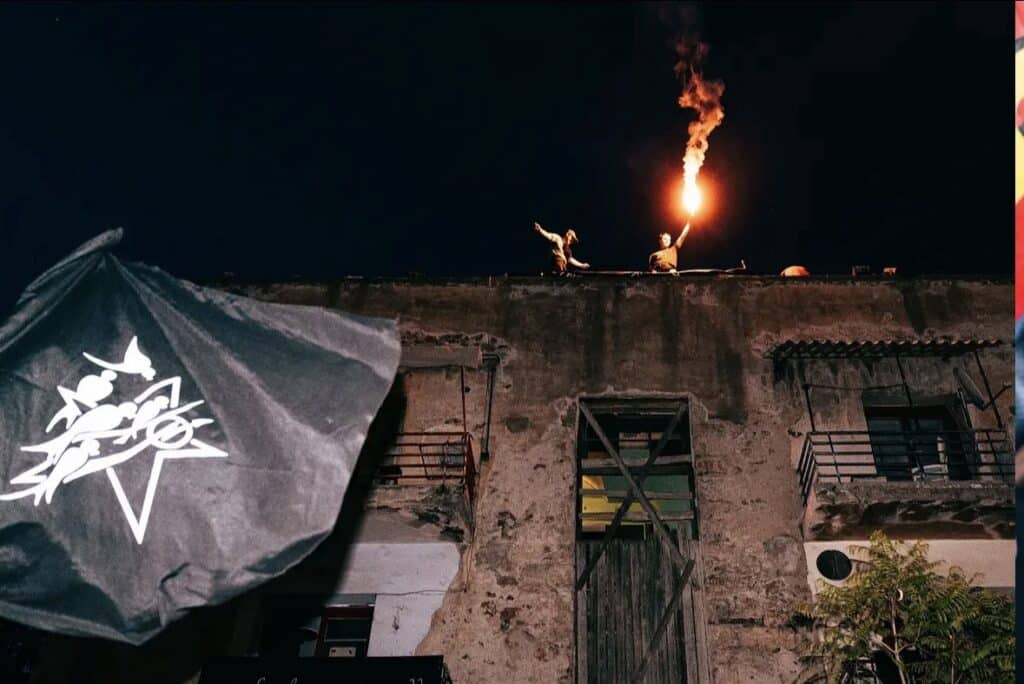
In the heart of Athens, the historic Prosfygika complex located on Alexandras Avenue represents far more than just a 1930s Bauhaus architectural landmark. It is a genuine self-managed, solidarity-based community, and the only de facto example of social housing in Greece—a country with 0% public residential housing. This vital space shelters over 400 people from 27 different countries, including 50 minors, the elderly, refugees, and vulnerable individuals. Left to decay by the state for decades, the complex has been transformed by its community into a model of mutual aid and urban resistance. However, top-down redevelopment plans driven by the logic of gentrification and real estate speculation threaten to erase this reality through a forced mass eviction, orchestrated in open violation of fundamental human rights.

Five Months of Resistance
The crisis reached a point of no return in mid-January 2026, when regional authorities confirmed their intention to clear the buildings through an imminent police operation. Faced with this threat and a total refusal of institutional dialogue, the protest escalated on February 5 with the commencement of a dramatic, indefinite hunger strike.
Over the last five months, this mobilization for life has catalyzed impressive participation. The movement’s strategy was not limited to mere physical resistance; it evolved into a powerful social strategy grounded in grassroots solidarity. The popular movement grew exponentially: thousands of citizens, activists, and allies repeatedly took to the streets of Athens, and across Europe, thousands of signatures were gathered from prominent cultural figures to defend the right to life, housing, and the city, while denouncing the lack of protections for the most vulnerable.
Parallel to the street and social mobilization, a thorough and formidable institutional strategy was pursued, built with the technical and internationalist support of the International Alliance of Inhabitants (IAI). This successfully transformed a local struggle into an international case of human rights defense.
International Attention and Political Pressure
The Prosfygika case quickly transcended Greek borders. In April, the IAI submitted a formal complaint letter¹ requesting urgent intervention from the UN Special Rapporteur on the right to adequate housing. The formal complaint meticulously details severe housing rights violations by the Greek state and the reckless use of European funds without any consultation. Newly appointed UN Special Rapporteur Koldo Casla sent a letter to the Greek government, which, according to official procedure, will be made public and widely disseminated in mid-July.
The importance of the Prosfygika model has also been recognized academically, officially becoming an international case study on housing violations at the University of Padua’s Center for Human Rights. Political pressure mounted across all institutional levels: urgent parliamentary questions² were submitted in the Hellenic Parliament to denounce the threat to the lives of the hunger strikers, and the tense, menacing public remarks made during government press briefings³ were strongly condemned. Meanwhile, in Brussels, a cross-party urgent inquiry to the European Commission, signed by 33 MEPs⁴, raised serious doubts regarding the legality of the Greek authorities’ actions, demanding accountability from the Commission over the deployment of EU funds in violation of the partnership principle and the right to adequate housing.
The Victory in City Hall and the Suspension of the Hunger Strike
This prolonged and multifaceted pressure yielded a historic result last Wednesday, June 24. The Mayor and the City Council of Athens took an official stance of unequivocal recognition and support for the community, voting to demand the immediate halt of the implementation of the Region’s programmatic contract and calling for the suspension of the hunger strike⁵. This initial political and institutional victory finally marked the end of the hunger strike, which lasted a gruelling 150 days. Yet, the human toll remains dramatic: the severe health risks have not yet been overcome, and the striker is currently in intensive care—a tragic testament to the level of violence triggered by state inaction. They have our full and affectionate solidarity.
Risks of Retaliation and Government Threats
Despite the victory achieved at the municipal level, the danger is far from over. The risks of heavy retaliation from the right-wing government and the Attica Region remain high. Attempting to bypass public opposition, the Region recently launched a controversial digital platform for the alleged “registration of needs” of Prosfygika residents⁶. This initiative is not the social consultation that was demanded; instead, it has been widely denounced as an attempt at mass profiling—a ploy to divide the community rather than a tool for genuine listening.
Rather than acknowledging this new state of affairs, the executive branch has issued severe threats. Government spokesperson Pavlos Marinakis irresponsibly attacked Prosfygika, labeling the community a “major blight” and sinisterly stating that “the competent authorities will answer regarding operational matters” («Για τα επιχειρησιακά θα απαντήσουν οι αρμόδιοι») ⁷. This is a crystal-clear message implying the intent to deploy police forces to resolve an eminently social issue through coercion and repression. The political target is the Municipality of Athens, deemed guilty of supporting dialogue with Prosfygika.
The Next Phase: The Dialogue Table and the Inclusive Alternative
Today, the movement enters a new and decisive phase. In this context, it is crucial to demand and facilitate the opening of a formal, concrete dialogue table. It is imperative that this process horizontally involves the community, its representatives, the Municipality of Athens, and international entities, in order to design and implement an innovative and fully inclusive redevelopment project⁸.
This struggle has already demonstrated how grassroots solidarity, paired with a robust legal and international strategy, can halt speculation and defend human rights even in the face of the most brutal pressure. The Greek government now stands at a crossroads: to irresponsibly persist on the path of criminalization and state violence, or to accept participatory democracy to save a heritage that is not only architectural, but above all, human.
Notes:
- Cover letter UN Special Rapporteur Housing on Prosfygika, Athens (03 04 2026) Google Drive Link
- Question to the Hellenic Parliament (Prot. 817, 30/04/2026): Hellenic Parliament Link
- Press briefing by Government Spokesperson P. Marinakis: Government.gov.gr Link
- Urgent cross-party question to the European Parliament signed by 33 MEPs: Europarl Link
- Resolution of the Municipality of Athens for the suspension of the regional agreement: City of Athens Link
- Launch of the profiling platform by the Attica Region: ProtoThema Link
- Statements by Marinakis on Prosfygika, Documento News: Documento News Link
- Proposal for an inclusive and innovative redevelopment project: Google Docs Link
Materials and In-Depth Documentation:
- 5 months of struggle by the Community of Occupied Prosfygika for the defense of life against the eviction plan by the Attica Region: Google Docs Link
- Tvxs.gr: Tvxs.gr Link